wip · Following physical signals from a sensor to locally visible information.
The ESP32 sensor node collects temperature, humidity and ambient-light readings from the workbench.
The useful part of the experiment is understanding the entire path: voltage at the sensor, conversion in the microcontroller, transport over the local network and presentation without a cloud service.
Current questions:
how much filtering belongs on the device;
how to preserve useful readings during network interruptions;
how little interface is necessary to understand what the room is doing.
Commands, configuration choices and explanations I want to be able to find again. These notes favor the reason behind a change, not only the final incantation.
The ESP32 sensor node collects temperature, humidity and ambient-light readings from the workbench.
The useful part of the experiment is understanding the entire path: voltage at the sensor, conversion in the microcontroller, transport over the local network and presentation without a cloud service.
Current questions:
how much filtering belongs on the device;
how to preserve useful readings during network interruptions;
how little interface is necessary to understand what the room is doing.
This experiment asks how little machinery a durable personal notebook needs.
The working constraints are plain files, offline operation, understandable synchronization and an export format that does not require the original application.
The interface is deliberately secondary. The first concern is whether the notes remain readable and movable after the software disappears.
A small device listens to a serial console, timestamps each line and writes rotating log files to local storage.
The logger should tolerate sudden power loss, make no assumptions about the target device and expose its files through an ordinary removable volume.
The next step is testing how it behaves with malformed output and long silent periods.
An old TV box that had been sitting unused is being turned into a node of the
home lab: something small that can run an Unbound DNS resolver or, later, an
MQTT broker.
flashed Armbian to an SD card and tried to boot from it;
the board did not boot from the SD card;
next step: understand why the RK3228 ignores the card.
The boot attempt on video:
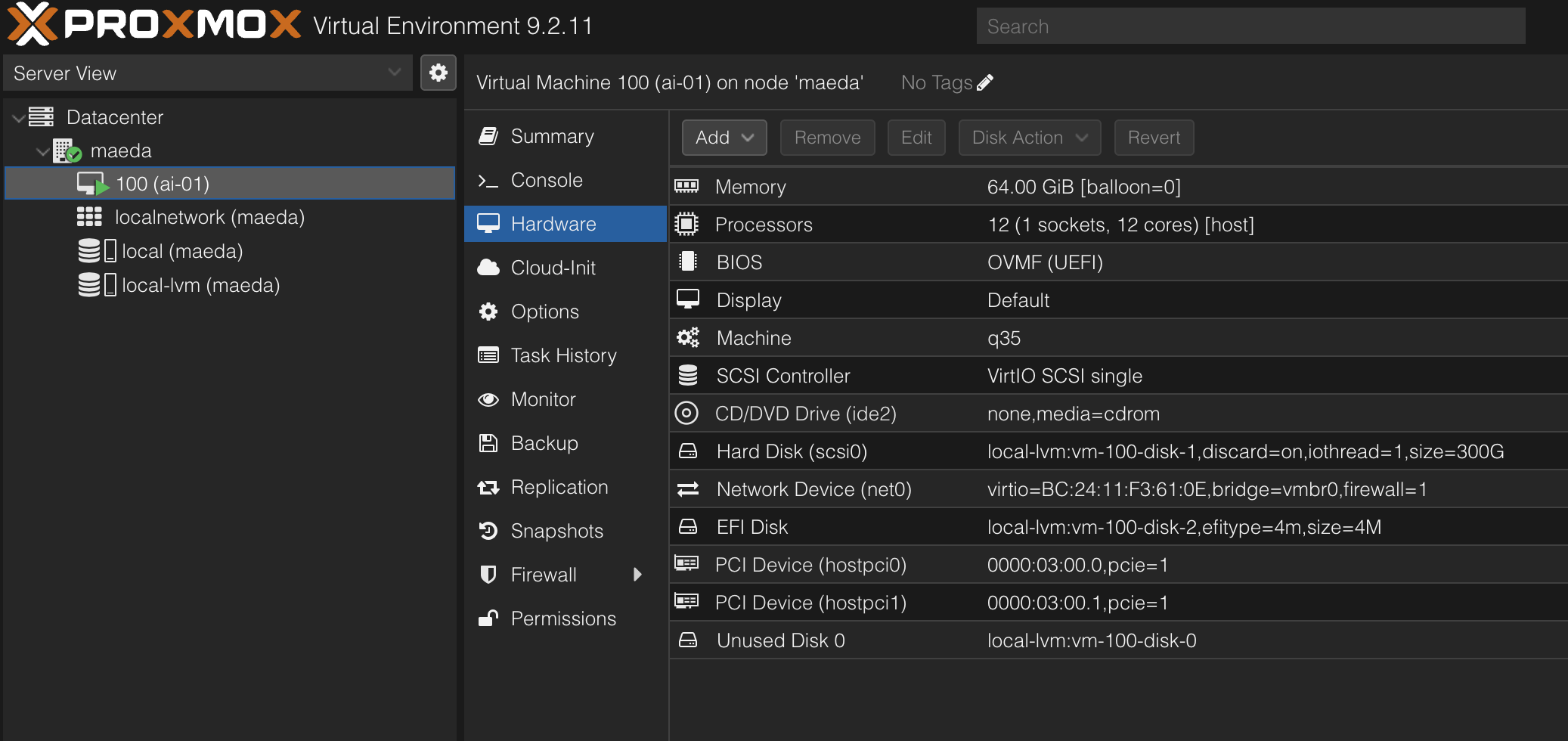
The workstation runs Proxmox VE. The first Linux VM is up — ai-01, an Ubuntu
Server with the RTX 5060 Ti passed through — and the first local models are
already running on it.
GPU passthrough worked end to end. Next: more guests, the storage layout and
the rest of the network.
The home lab's network is being wired into a rack: a managed switch, the edge
router and the machines, all talking to each other. This is the plumbing every
other experiment runs on.
Still in progress: cable runs, VLANs and which machine gets which port.
After putting the 16 GB RTX 5060 Ti inside ai-01 via PCI passthrough on Proxmox, I ran some simple llama.cpp tests before thinking about a more robust stack. The chain was Proxmox → VFIO → Ubuntu Server 26.04 → NVIDIA 595-open → CUDA 13.x → llama.cpp → GGUF.
I used the same prompt for every test and kept -ngl 99 to offload almost everything to the GPU:
Model
Quantization
Prompt (t/s)
Generation (t/s)
Qwen3-4B
Q4_K_M
797.7
125.6
Qwen3-8B
Q4_K_M
677.9
78.9
Qwen3-14B
Q4_K_M
493.4
44.9
Qwen3-14B
Q5_K_M
459.6
39.4
The Qwen3-14B in Q5_K_M took about 14.8 GB of the 16.3 GB available, so it seems very close to the card's comfortable limit. Even so, almost 40 tokens per second is more than enough for interactive use. So far this 14B Q5 looks like the most interesting point between model size, quantization quality and speed.
On top of these models I'm also testing coding-agent harnesses. DSH (DeepSeek Harness) is the main one; OpenCode and Pi (coding agent) are queued next.
The next experiment is to deliberately exceed 16 GB of VRAM with larger models, in the 20B to 32B range, to observe the cost of splitting the model between GPU and RAM. The question that started as "which model is fastest?" is already turning into something more useful: what is the best model that still answers faster than I can read?
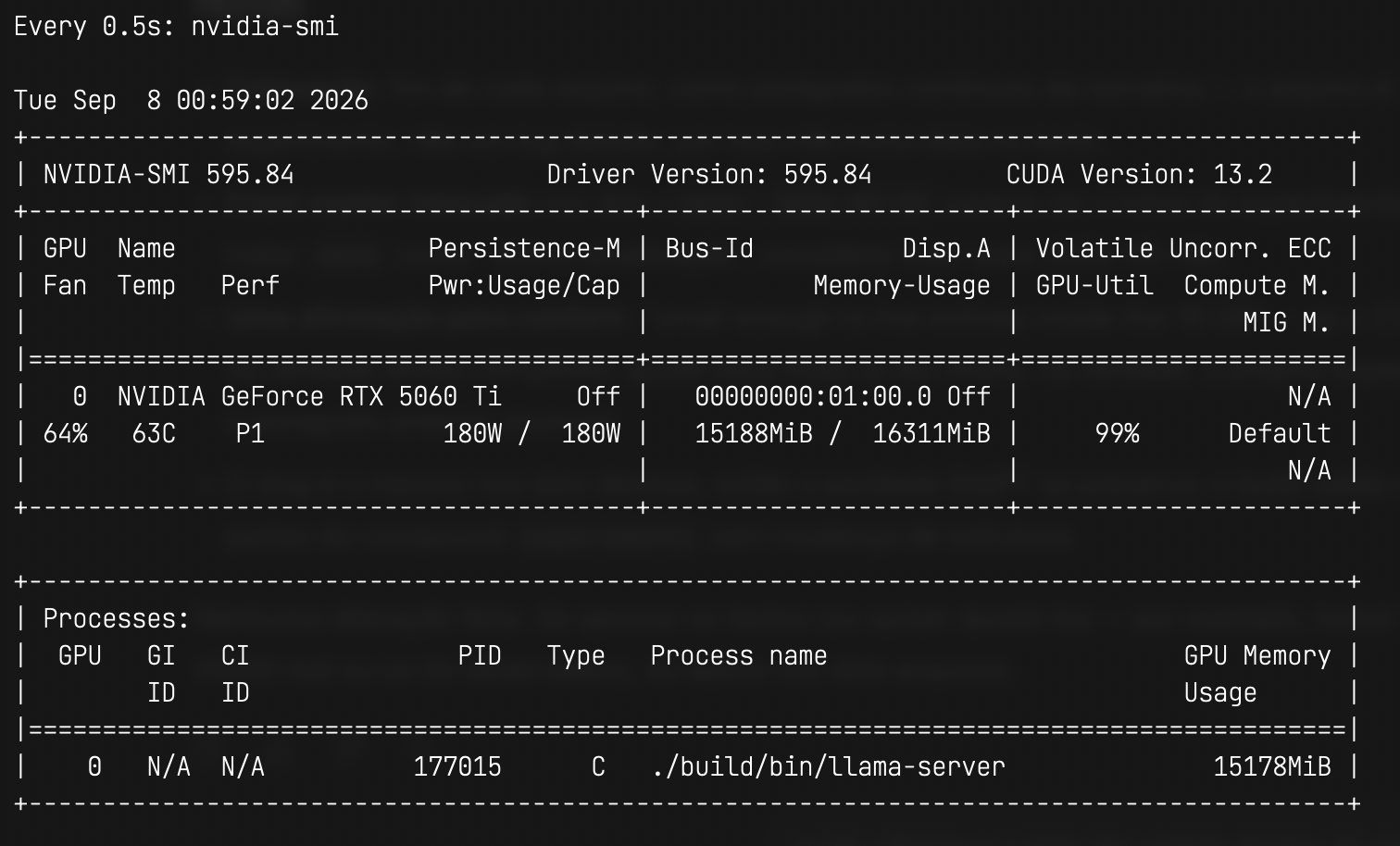
2026-09-06 — before the VRAM experiment, the first real harness test happened. I ran llama-server on ai-01 with the bartowski Qwen3.8-27B-IQ3_XXS GGUF — a 27B model that lives 100% in VRAM, at 15188 MiB of the 16311 MiB available — and pointed DSH, running on the MacBook, at the VM. First time the harness and the model were on different machines: the laptop stays the interface, the workstation does the work.
One friction point: DSH expects an API key, and llama-server does not issue one. The fix was trivial — the field accepts any value, so it now says local, a placeholder honest about what it is.
The results are satisfactory for interactive use. Before the 20B-to-32B experiment, two things to record: whether the IQ3_XXS quantization holds up under long agent sessions, and how much latency the hop from the MacBook to the VM actually adds.
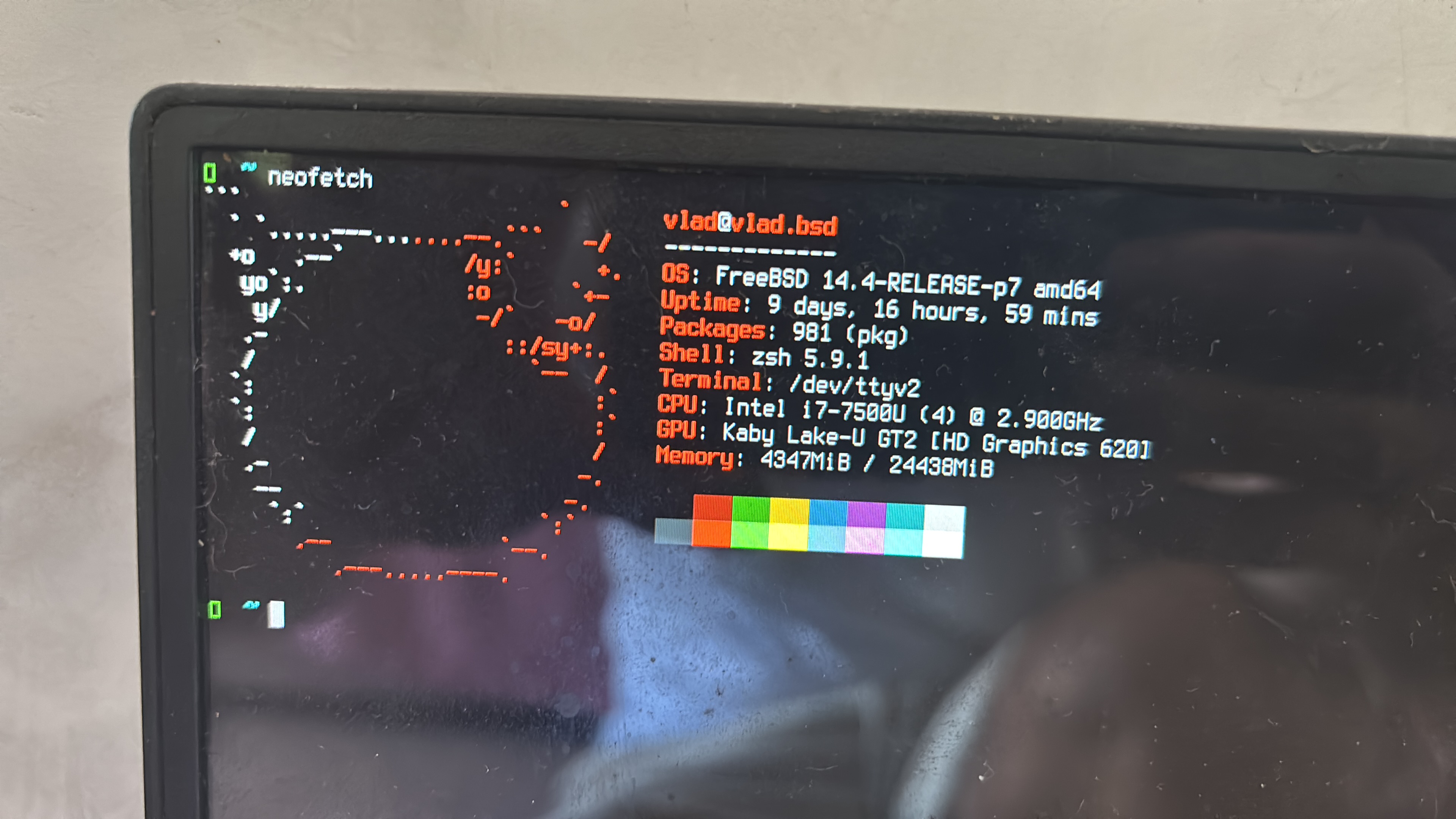
Placeholder — notes about the FreeBSD box will go here.
Placeholder — notes about the ESP32 bench will go here.
The main machine of the lab. Booted and running Proxmox as its hypervisor.
Intended for software development, local models, agent experiments, virtual
machines and general-purpose computing.